Recap: From Hype to Impact — AI in Financial Markets 2026

On Tuesday 20 October, we attended AI in Financial Markets 2026: From Hype to Impact, hosted by Future of Finance. The afternoon brought together practitioners, investors and technologists to ask: is AI delivering real value in finance, or are we in a bubble?
Across a keynote and a series of panels, discussion ranged from the economics of AI investment to regulation, accountability and the practical limits of today’s models. A recurring theme was that the technology itself holds real promise, but whether it pays off depends on how carefully organisations choose to deploy it.
The first panel, What is different about the AI bubble?, framed the afternoon around a single question:
One speaker highlighted the circular nature of much of today’s AI financing, where, for example, chip manufacturers invest in AI companies that then buy their chips. It’s estimated that around half of all AI investment now comes from other AI companies.
History offers some perspective. Innovators have typically captured only around 2% of the value their technologies create, with the remaining 98% flowing elsewhere, i.e., to customers, workers, suppliers and the broader economy. For the current wave of spending to pay off, AI would need to raise productivity by around 2%. As the speaker put it, if we want to make progress, we’re going to need to waste a lot of money — and while the details change, “Human financial folly endures”.
When asked directly if a case can be made for AI investment at this scale, one panellist argued that the case is stronger for the technology than for the way it is being financed, and investors need to be careful about what exactly they are backing. Another panellist compared AI to the railway boom: many railway companies went bust, but society was left with the rails — a net good.
When asked about the possibility that an AI-induced ‘job apocalypse’ will cancel out the returns on all this investment, the panel was cautiously optimistic. AI accelerates almost everything, and could free people to reskill into more meaningful roles.
On regulation, the panel started from the point that regulators are always behind the technical curve. The EU AI Act has pushed governance up the enterprise agenda, though GDPR has arguably had the bigger impact so far. The UK’s approach differs structurally rather than simply lagging behind. The UK Jurisdiction Taskforce is interpreting how existing negligence law applies to AI, while a Law Commission paper proposes strict liability for AI developers, regardless of whether harm was foreseeable. This would be a significant shift in legal exposure.
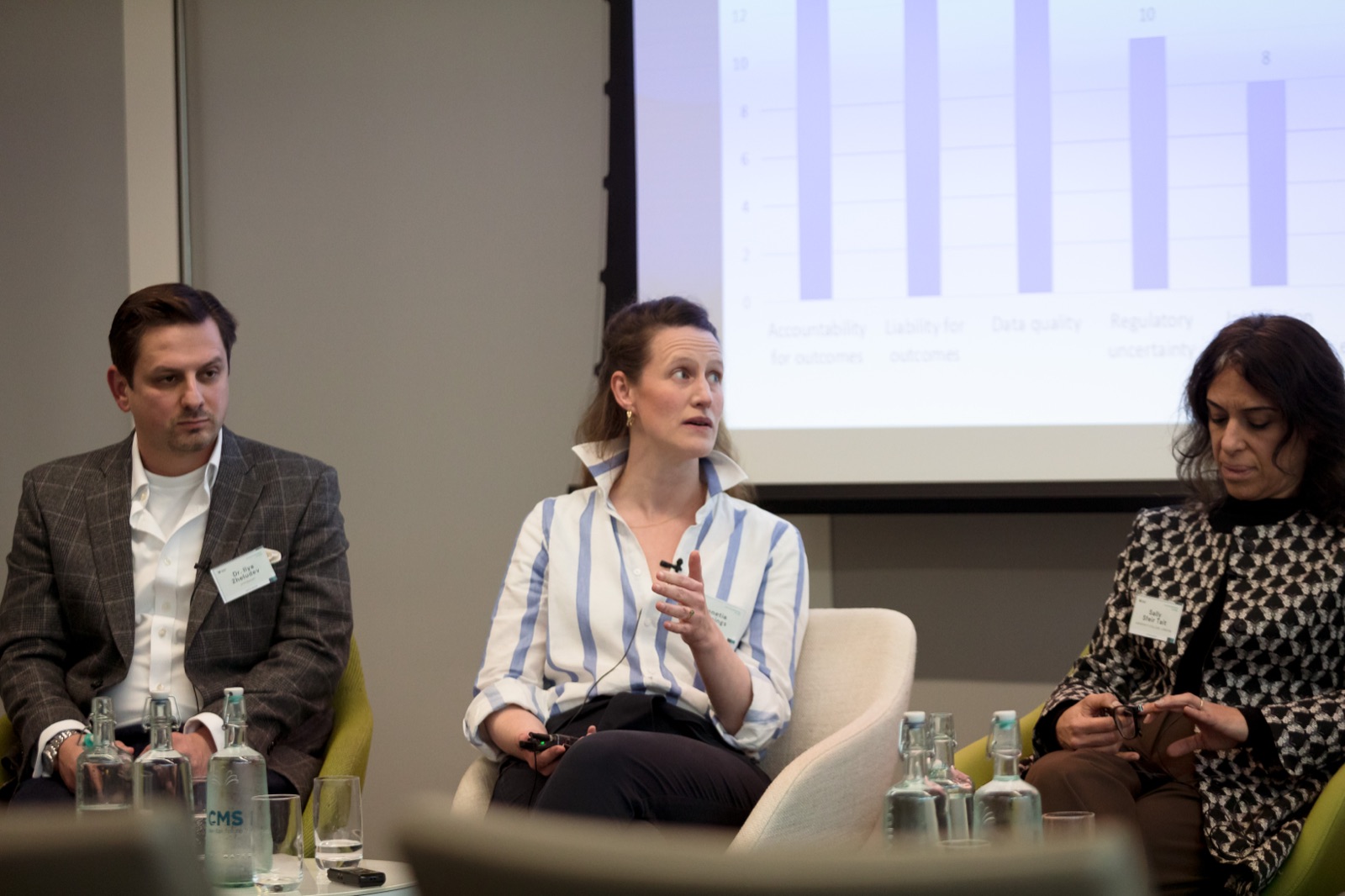
The panel, Does AI work?, began with the question: do the limits lie with AI technology or the organisations adopting it? The panel’s answer was both. When we talk about AI today, we’re usually talking about large language models, which have structural limitations — their outputs aren’t guaranteed, they act as black boxes, and small differences in input can lead to very different outputs. Because they learn from historical data, they carry pitfalls like any other technology, and it’s the user’s responsibility to keep those in mind.
On the organisational side, many organisations don’t have a clear understanding of the processes they perform. Eliciting those processes is hard, which makes return on investment difficult to demonstrate — and, as one panellist noted, saving 10% of ten people’s time is not the same as freeing up one full-time role. Hard evidence of returns remains thin.
The discussion closed on automation bias. Humans reason by induction: if something has been right nine times, we expect it to be right the tenth. Regulation can make people accountable, but it doesn’t stop the natural tendency to trust the output. Panellists warned that people can lose skills they always had — and fail to learn new ones without realising it. This isn’t a new problem: Lisanne Bainbridge’s paper Ironies of Automation (1983) showed that operators who are switched off 90% of the time are far less effective in the remaining 10%. The practical lesson is that AI is not always the right tool.

Across all the discussions, one thing was clear:
Regardless of the scale of investment, AI that is not trusted cannot be deployed in critical industries. This is the key issue being addressed by our High Assurance AI Programme, which is building the technical foundations to make safe, compliant AI deployment achievable in critical and regulated industries, with an initial focus on financial services.
For a full summary of each session, see Future of Finance’s key takeaways from the event.